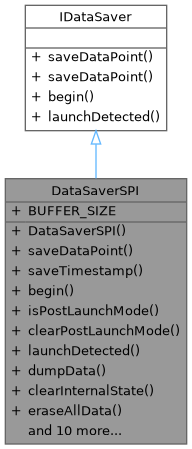
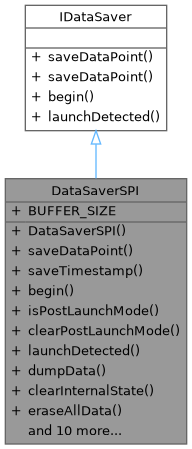
SPI flash implementation of IDataSaver with timestamp compression. More...
#include <DataSaverSPI.h>
Public Member Functions | |
| DataSaverSPI (uint16_t timestampInterval_ms, Adafruit_SPIFlash *flash) | |
| Construct a new DataSaverSPI object. | |
| int | saveDataPoint (const DataPoint &dataPoint, uint8_t name) override |
| Saves a DataPoint to SPI flash. | |
| int | saveTimestamp (uint32_t timestamp_ms) |
| Persist a bare timestamp entry to flash. | |
| virtual bool | begin () override |
| Initialize the flash chip and metadata. | |
| bool | isPostLaunchMode () |
| Returns whether the metadata from the flash chip indicates that it contains post-launch data that hasn't been dumped yet. Call clearPostLaunchMode() to clear this flag. once you are confident that you have the data you want dumped to a more permanent storage or another machine. | |
| void | clearPostLaunchMode () |
| Clears the post-launch mode flag on the flash chip **WARNING: This will allow the data to be overwritten Only call this after you have dumped the data to a more permanent storage or another machine. | |
| void | launchDetected (uint32_t launchTimestamp_ms) |
| Call this when launch is detected to set the post-launch flag and prevent any data from being overwritten until the flag is cleared. All data written from this point on is "post-launch" data which is sacred and should not be overwritten until it has been dumped. | |
| void | dumpData (Stream &serial, bool ignoreEmptyPages) |
| Stream all recorded data to a serial connection. | |
| void | clearInternalState () |
| Reset in-memory pointers without erasing flash contents. | |
| void | eraseAllData () |
| Erase the entire flash chip to start fresh. | |
| uint32_t | getLastTimestamp () const |
| Returns the last timestamp that was actually written to flash. | |
| DataPoint | getLastDataPoint () const |
| Returns the last DataPoint that was written (not necessarily including timestamp, just the data chunk). | |
| uint32_t | getLaunchWriteAddress () const |
| Returns the launch-protected address computed during launch detection. | |
| uint32_t | getNextWriteAddress () const |
| Returns the next flash address where a full page will be written. | |
| void | resetTimestamp () |
| Resets the timestamp to 0. Can be used to start a new flight during runtime. Useful for testing. | |
| bool | quickGetPostLaunchMode () |
| Returns whether the flash chip is in post-launch mode without updating the post-launch mode flag or reading from flash. | |
| size_t | getBufferIndex () const |
| Returns the current buffer index Useful for testing. | |
| uint32_t | getBufferFlushes () const |
| Returns the current buffer flush count Useful for testing. | |
| bool | getIsChipFullDueToPostLaunchProtection () const |
| Returns whether writes have been stopped by post-launch protection. | |
| bool | getRebootedInPostLaunchMode () const |
| Returns whether startup detected existing post-launch mode metadata. | |
| Public Member Functions inherited from IDataSaver | |
| virtual | ~IDataSaver ()=default |
| virtual int | saveDataPoint (float data, uint32_t timestamp_ms, uint8_t name) final |
| Convenience overload to construct and save a data point. | |
Static Public Attributes | |
| static constexpr size_t | kBufferSize_bytes = 256 |
Detailed Description
SPI flash implementation of IDataSaver with timestamp compression.
- Note
- When to use: onboard non-volatile logging where SD cards are impractical and data may need to survive power loss or long recovery.
Definition at line 40 of file DataSaverSPI.h.
Constructor & Destructor Documentation
◆ DataSaverSPI()
| DataSaverSPI::DataSaverSPI | ( | uint16_t | timestampInterval_ms, |
| Adafruit_SPIFlash * | flash ) |
Construct a new DataSaverSPI object.
- Parameters
-
timestampInterval_ms Interval in ms at which timestamps are stored flash Pointer to an initialized Adafruit_SPIFlash object
- Note
- timestampInterval_ms must be < 65535 (about 1 minute)
Definition at line 7 of file DataSaverSPI.cpp.
Member Function Documentation
◆ begin()
|
overridevirtual |
Initialize the flash chip and metadata.
- Note
- When to use: call during setup before any saveDataPoint usage.
- Returns
- true when flash is initialized and writable for logging.
- false when initialization fails or chip is already in post-launch mode.
Reimplemented from IDataSaver.
Definition at line 172 of file DataSaverSPI.cpp.
◆ clearInternalState()
| void DataSaverSPI::clearInternalState | ( | ) |
Reset in-memory pointers without erasing flash contents.
- Note
- When to use: restart logging logic while preserving prior data on the chip.
Definition at line 293 of file DataSaverSPI.cpp.
◆ clearPostLaunchMode()
|
virtual |
Clears the post-launch mode flag on the flash chip **WARNING: This will allow the data to be overwritten Only call this after you have dumped the data to a more permanent storage or another machine.
Reimplemented from IDataSaver.
Definition at line 197 of file DataSaverSPI.cpp.
◆ dumpData()
| void DataSaverSPI::dumpData | ( | Stream & | serial, |
| bool | ignoreEmptyPages ) |
Stream all recorded data to a serial connection.
- Parameters
-
serial Output stream. ignoreEmptyPages Skip pages that appear unwritten.
- Note
- When to use: post-flight data retrieval before erasing or redeploying the flash chip.
Definition at line 206 of file DataSaverSPI.cpp.
◆ eraseAllData()
| void DataSaverSPI::eraseAllData | ( | ) |
Erase the entire flash chip to start fresh.
- Note
- When to use: Never needs to be used in normal operation. After about 1 hour of runtime, the entire chip is overwritten anyways. Can be used in testing to reset the chip to a known state and then test which bytes are written
Definition at line 306 of file DataSaverSPI.cpp.
◆ getBufferFlushes()
|
inline |
Returns the current buffer flush count Useful for testing.
- Returns
- Number of successful page flushes.
Definition at line 267 of file DataSaverSPI.h.
◆ getBufferIndex()
|
inline |
Returns the current buffer index Useful for testing.
- Returns
- Number of bytes currently buffered.
Definition at line 258 of file DataSaverSPI.h.
◆ getIsChipFullDueToPostLaunchProtection()
|
inline |
Returns whether writes have been stopped by post-launch protection.
- Returns
- true if chip-full post-launch protection latch is set; otherwise false.
Definition at line 275 of file DataSaverSPI.h.
◆ getLastDataPoint()
|
inline |
Returns the last DataPoint that was written (not necessarily including timestamp, just the data chunk).
- Returns
- Copy of the last cached data point.
Definition at line 167 of file DataSaverSPI.h.
◆ getLastTimestamp()
|
inline |
Returns the last timestamp that was actually written to flash.
- Returns
- Last persisted timestamp in milliseconds.
Definition at line 158 of file DataSaverSPI.h.
◆ getLaunchWriteAddress()
|
inline |
Returns the launch-protected address computed during launch detection.
- Returns
- Address in flash used as post-launch protection boundary.
Definition at line 175 of file DataSaverSPI.h.
◆ getNextWriteAddress()
|
inline |
Returns the next flash address where a full page will be written.
- Returns
- Next write address in flash.
Definition at line 183 of file DataSaverSPI.h.
◆ getRebootedInPostLaunchMode()
|
inline |
Returns whether startup detected existing post-launch mode metadata.
- Returns
- true if rebooted in post-launch mode; otherwise false.
Definition at line 283 of file DataSaverSPI.h.
◆ isPostLaunchMode()
| bool DataSaverSPI::isPostLaunchMode | ( | ) |
Returns whether the metadata from the flash chip indicates that it contains post-launch data that hasn't been dumped yet. Call clearPostLaunchMode() to clear this flag. once you are confident that you have the data you want dumped to a more permanent storage or another machine.
Will also update the post-launch mode flag.
- Returns
- true if post-launch mode is active
- false if post-launch mode is not active
Definition at line 190 of file DataSaverSPI.cpp.
◆ launchDetected()
|
virtual |
Call this when launch is detected to set the post-launch flag and prevent any data from being overwritten until the flag is cleared. All data written from this point on is "post-launch" data which is sacred and should not be overwritten until it has been dumped.
Sets the post-launch mode flag to true on the flash chip. Records the address at which the launch was detected and ensures that it's not overwritten
Data is saved in a circular fashion but once the address where the launch detected is reached this will stop saving data entirely. Also keeps 1 minute of data from before the launch was detected (b/c launch can be detected late and we have extra room)
The rocket may not be recovered for several hours, this prevents the cool launch data from being overwitten with boring laying-on-the-ground data.
- Parameters
-
launchTimestamp_ms Timestamp at which launch was detected.
Reimplemented from IDataSaver.
Definition at line 317 of file DataSaverSPI.cpp.
◆ quickGetPostLaunchMode()
|
inline |
Returns whether the flash chip is in post-launch mode without updating the post-launch mode flag or reading from flash.
- Returns
- true when in post-launch mode; otherwise false.
Definition at line 200 of file DataSaverSPI.h.
◆ resetTimestamp()
|
inline |
Resets the timestamp to 0. Can be used to start a new flight during runtime. Useful for testing.
Definition at line 191 of file DataSaverSPI.h.
◆ saveDataPoint()
|
overridevirtual |
Saves a DataPoint to SPI flash.
If the new data point’s timestamp differs from the last written timestamp by more than timestampInterval_ms_, the new timestamp is also written to flash. Otherwise, the timestamp is omitted (to save space).
- Parameters
-
dataPoint The data point to save name An 8-bit “identifier” for the data point (could be a sensor ID)
- Returns
- int 0 on success, 1 when writes are blocked by post-launch state, and -1 on write/buffer error.
Implements IDataSaver.
Definition at line 21 of file DataSaverSPI.cpp.
◆ saveTimestamp()
| int DataSaverSPI::saveTimestamp | ( | uint32_t | timestamp_ms | ) |
Persist a bare timestamp entry to flash.
- Parameters
-
timestamp_ms Timestamp in milliseconds to record.
- Note
- When to use: emitted internally when gaps exceed timestampInterval_ms_, or explicitly in tests.
- Returns
- int 0 on success, 1 when writes are blocked by post-launch state, and -1 on non-post-launch write/buffer error.
Definition at line 47 of file DataSaverSPI.cpp.
Member Data Documentation
◆ kBufferSize_bytes
|
staticconstexpr |
Definition at line 43 of file DataSaverSPI.h.
The documentation for this class was generated from the following files: