Detects the apogee (peak altitude) of a rocket flight using estimated altitude and vertical velocity. More...
#include <ApogeeDetector.h>
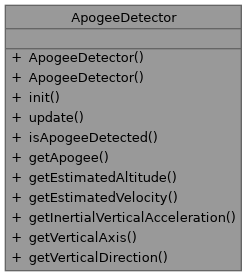
Public Member Functions | |
| ApogeeDetector (float apogeeThreshold_m) | |
| Constructs an ApogeeDetector with a custom drop threshold. | |
| ApogeeDetector () | |
| Constructs an ApogeeDetector with the default threshold of 1.0 meter. | |
| void | init (ApogeeDetectorInitialState initialState) |
| Initializes the detector with the starting altitude and timestamp. | |
| void | update (VerticalVelocityEstimator *verticalVelocityEstimator) |
| Updates the detector using the latest estimated altitude and vertical velocity. | |
| bool | isApogeeDetected () const |
| Checks if apogee has been detected. | |
| DataPoint | getApogee () const |
| Retrieves the detected apogee. | |
| float | getEstimatedAltitude () const |
| Gets the current estimated altitude. | |
| float | getEstimatedVelocity () const |
| Gets the current estimated vertical velocity. | |
| float | getInertialVerticalAcceleration () const |
| Gets the current inertial vertical acceleration. | |
| int8_t | getVerticalAxis () const |
| Gets the configured vertical axis. | |
| int8_t | getVerticalDirection () const |
| Gets the configured vertical direction (+1 or -1). | |
Detailed Description
Detects the apogee (peak altitude) of a rocket flight using estimated altitude and vertical velocity.
The detector uses data from a VerticalVelocityEstimator (e.g., a Kalman filter fusing an altimeter and accelerometer). Apogee is detected when:
- The vertical velocity becomes negative.
- The estimated altitude drops by at least a configurable threshold after reaching a maximum.
Acceleration assumptions:
- The accelerometer (e.g., LSM6DSOX) measures the "normal force" and outputs ~9.81 m/s² at rest.
- During free fall or coasting, its output approaches 0.
- Therefore, inertial acceleration = measured acceleration − 9.81 m/s².
- Note
- When to use: flights where apogee-triggered events (e.g., drogue deployment) must be driven by fused altimeter/IMU estimates rather than a single sensor.
Definition at line 33 of file ApogeeDetector.h.
Constructor & Destructor Documentation
◆ ApogeeDetector() [1/2]
|
explicit |
Constructs an ApogeeDetector with a custom drop threshold.
- Parameters
-
apogeeThreshold_m Minimum drop in altitude (in meters) to confirm apogee.
Definition at line 5 of file ApogeeDetector.cpp.
◆ ApogeeDetector() [2/2]
|
inline |
Constructs an ApogeeDetector with the default threshold of 1.0 meter.
Definition at line 44 of file ApogeeDetector.h.
Member Function Documentation
◆ getApogee()
| DataPoint ApogeeDetector::getApogee | ( | ) | const |
Retrieves the detected apogee.
- Returns
- A DataPoint containing the timestamp and altitude of apogee. If not detected, returns {0, 0.0F}.
Definition at line 43 of file ApogeeDetector.cpp.
◆ getEstimatedAltitude()
| float ApogeeDetector::getEstimatedAltitude | ( | ) | const |
Gets the current estimated altitude.
- Returns
- Altitude in meters.
◆ getEstimatedVelocity()
| float ApogeeDetector::getEstimatedVelocity | ( | ) | const |
Gets the current estimated vertical velocity.
- Returns
- Velocity in meters per second.
◆ getInertialVerticalAcceleration()
| float ApogeeDetector::getInertialVerticalAcceleration | ( | ) | const |
Gets the current inertial vertical acceleration.
- Returns
- Vertical acceleration in m/s², corrected for gravity.
◆ getVerticalAxis()
| int8_t ApogeeDetector::getVerticalAxis | ( | ) | const |
Gets the configured vertical axis.
- Returns
- Axis index used as vertical (0=X, 1=Y, 2=Z).
◆ getVerticalDirection()
| int8_t ApogeeDetector::getVerticalDirection | ( | ) | const |
Gets the configured vertical direction (+1 or -1).
- Returns
- 1 if increasing values mean upward, -1 otherwise.
◆ init()
| void ApogeeDetector::init | ( | ApogeeDetectorInitialState | initialState | ) |
Initializes the detector with the starting altitude and timestamp.
- Parameters
-
initialState Struct containing initial altitude and timestamp.
Definition at line 10 of file ApogeeDetector.cpp.
◆ isApogeeDetected()
| bool ApogeeDetector::isApogeeDetected | ( | ) | const |
Checks if apogee has been detected.
- Returns
- true if apogee has occurred, false otherwise.
Definition at line 37 of file ApogeeDetector.cpp.
◆ update()
| void ApogeeDetector::update | ( | VerticalVelocityEstimator * | verticalVelocityEstimator | ) |
Updates the detector using the latest estimated altitude and vertical velocity.
- Parameters
-
verticalVelocityEstimator Pointer to the estimator providing current flight state.
Definition at line 18 of file ApogeeDetector.cpp.
The documentation for this class was generated from the following files: